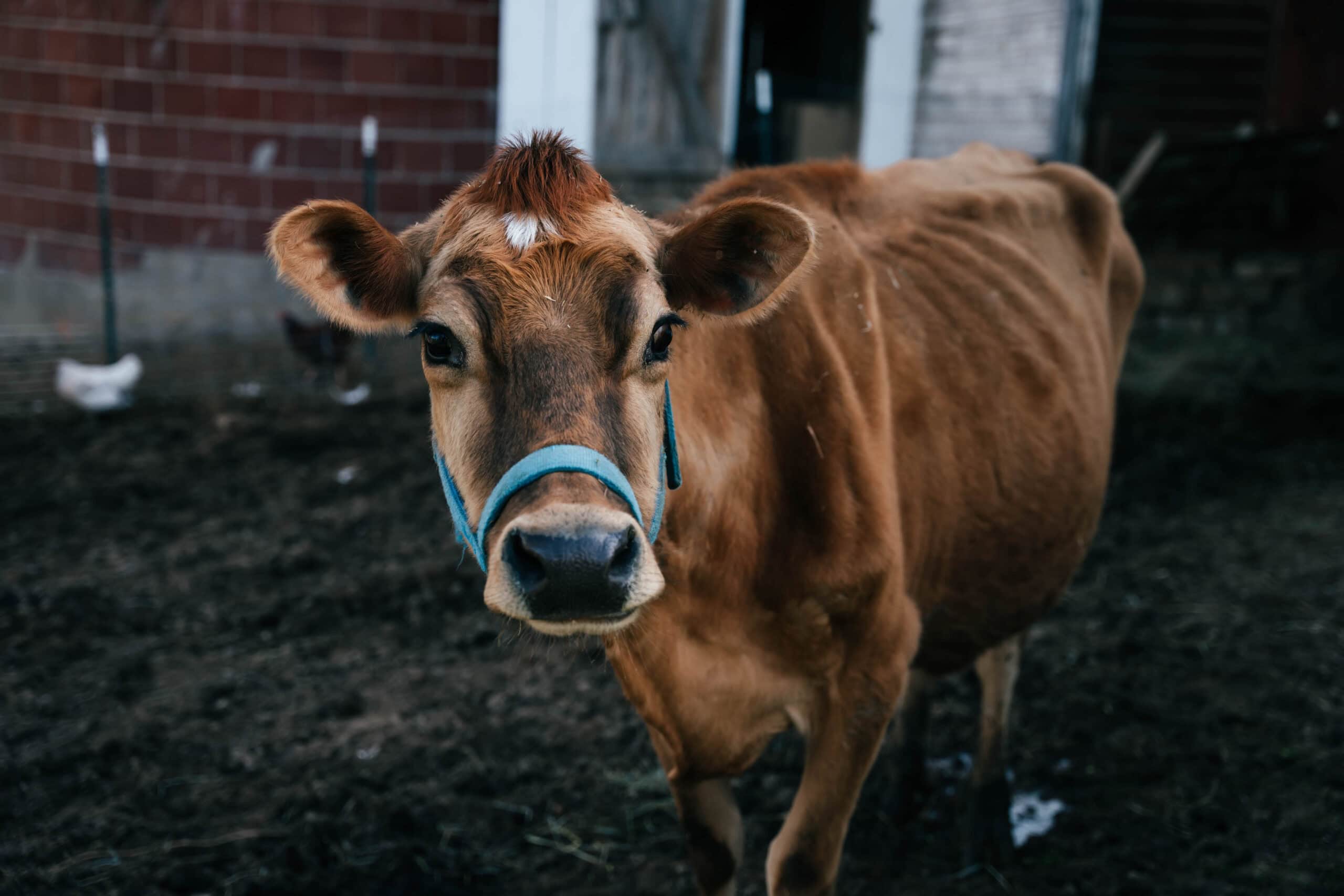
You might ask, How will I recognize that “best” cow when I see her? Well, the short answer is: It depends. The Doughertys recommend you prioritize a couple non-negotiables, and then consider her other traits based on your land and your family’s needs.
Let’s dive in now to get a fuller picture of what our future dairy cow may look like.
SERIES: Article 1 | ▶ Article 2 (this one) | Article 3 | Article 4 | Article 5
This is Article 2 of a five-part series on keeping a family milk cow, built from the School of Traditional Skills class Keeping The Family Dairy Cow with instructors Shawn and Beth Dougherty. Catch up with Article 1 on deciding whether a cow is right for you, or continue to Article 3 on the costs of a family milk cow, Article 4 on milking for beginners, and Article 5 on the lifecycle and care of a dairy cow.
Why the Right Cow Solves Most of Your Problems Before You Buy Her
Like most things having to do with the homestead, finding the right dairy cow and setting up a good system takes a little forethought, effort, and time.
The idea is for the addition to ultimately prove beneficial instead of frustrating. To that end, be patient until you’ve found the right cow locally, from a source you trust, with the qualities required by your family and homestead. As the saying goes, good things come to those who wait
Compared with buying the wrong cow, the right animal can save you a lot of headaches down the line. For instance, a calm, well-built cow with desirable traits should help you steer clear of many challenges from the get-go, be it kicking or other milking and health issues.
The good news is that homestead milk cows are now in high demand and trading hands frequently. With plenty of great cows available, you never need to settle (although remember that a good enough cow is better than no cow). To quote Beth Dougherty, “There are too many nice cows out there. Buy a nice cow. Don't buy one that's going to cause problems for you.”
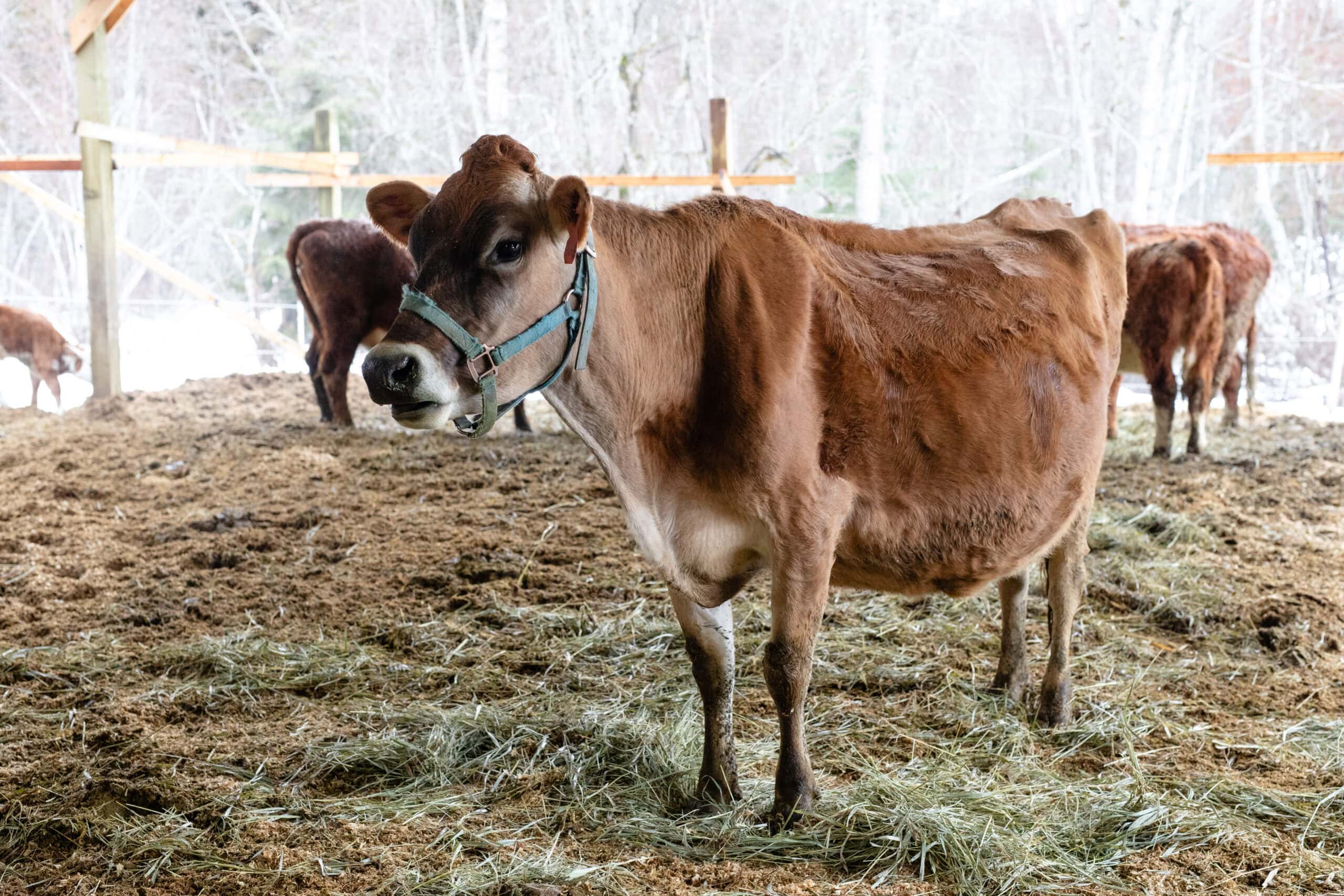
The Two Non-Negotiables: Temperament and Teat Size
After decades of milking dairy cows, Shawn and Beth have two key pieces of advice for new buyers. First, focus on temperament and find a pleasant milk cow that will work with you. Go for personality first, because the other things, while important, are less so. “The attitude is very significant,” Shawn says. “If you have an animal that is skittish, that is a kicker, […] it’s not worth the risk of getting hurt.”
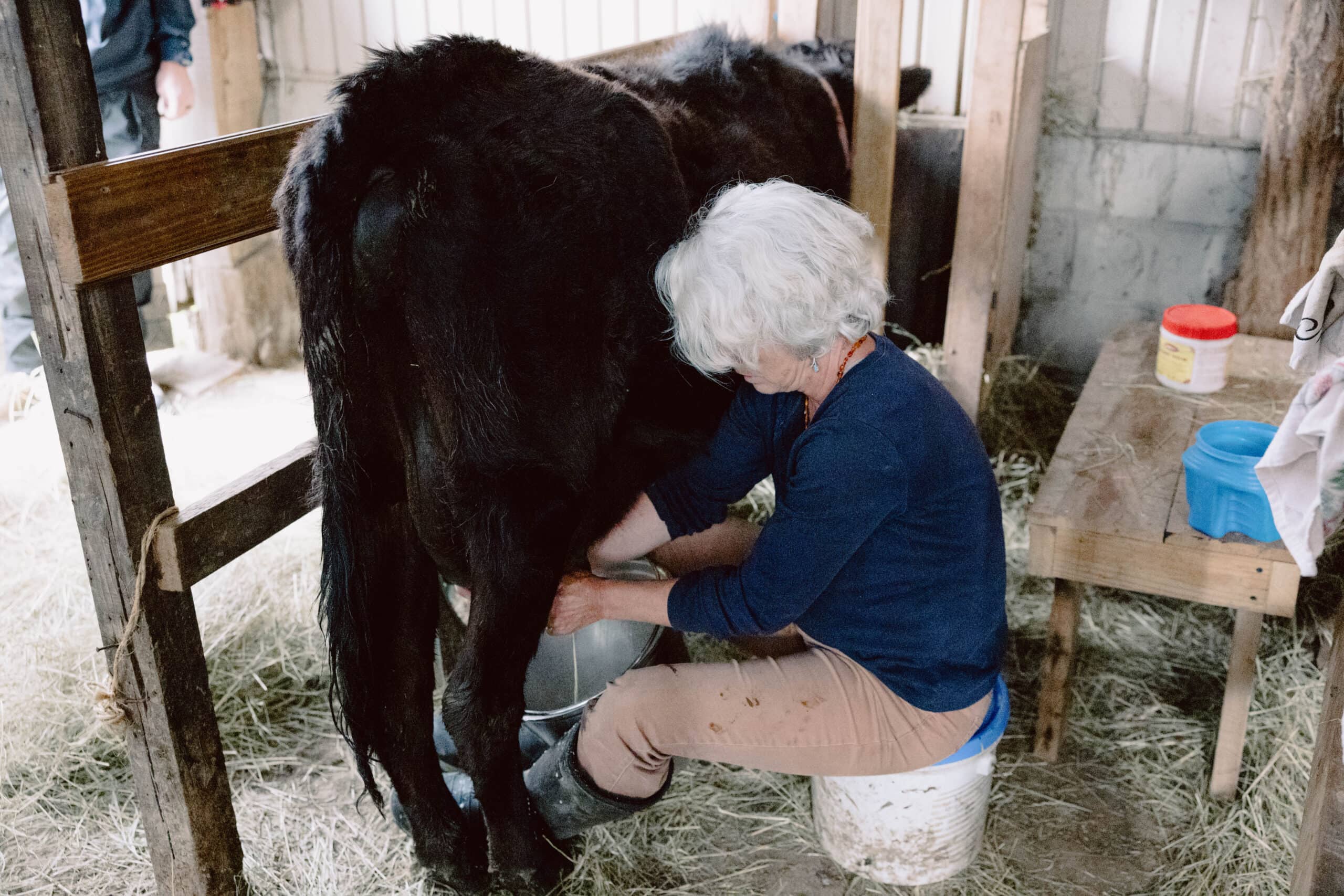
The second quality they recommend is appropriate teat shape and size, because your success in milking – after personality – depends largely on mechanics. If you plan to hand milk (and the Doughertys strongly advise it), “You really don't want to take a chance on a very short teat. If you can't properly grasp a teat, you'll find yourself milking with thumb and one or two fingers. Now a few motions like this aren't very trying, but imagine that you're going to do this motion 300, 400 times and pretty soon your hands are going to cramp up.” Small teats also make hand milking painfully slow and are hard on a nursing calf, too.
The best way to test both of these traits is to meet the cow you’re assessing in person. Before you buy, physically test her temperament: run your hand down her rump, down her hind leg, and reach around to her udder. Get a look at her teat size while you’re at it. If she kicks at any of that, she’s out. A good dairy cow likes being milked, so there is no reason to commit to one that resists being handled from the very first meeting.
What other qualities are helpful to have in a cow? The Doughertys have identified at least 13 other traits in their cow-selection checklist. To see the full list, what they say about each of those qualities, and how to rank them in your own assessment, look at their class on Keeping The Family Dairy Cow or their new book on the family dairy cow linked below.
Keeping the Family Dairy Cow
Join Shawn Dougherty from the One Cow Revolution as he teaches you how doable it is to own a family milk cow and have a full, modern life while enjoying the incredible benefits she provides for your entire homestead!
Nice-to-Haves You Can Be Flexible On
Beyond our two non-negotiables of temperament and teat size, there are several other qualities that you should consider when you’re looking for a dairy cow. As you research available cows in your area, keep these in the back of your mind and decide which ones matter most to you. You’re not likely to find the “perfect” cow, but you may just find one that really suits your situation.
Diet: A grass-fed background is a real plus. The more grass has been her primary food, the better she will do on your homestead. If your only option is a cow that’s been on grain, go for one that’s younger, since they're easier to wean off grain than older cows.
Containment: A cow that comes fence-trained to electric fencing or a tether is ideal, but this can be taught if lacking. Ultimately, her cooperation with your mobile pasture fences will be a crucial element of your rotational grazing system!
Chemical and Pharmaceutical History: Chemical and vaccine history is worth asking about in detail (what was given, how often, and when). While the Doughertys acknowledge that maximum avoidance here is preferable, they don’t recommend making this a deal-breaker if a cow otherwise checks all the important boxes.
Other Considerations: Traits like A2/A2 genetics or mini breeds sound appealing but are not automatically better, though they may be trendy. Get clarity on what traits matter most to your family before you pay extra for these characteristics.
How Much Land Does One Cow Actually Need
One of the most common questions that the Doughertys field is, “Do I have enough land?” There is no single right answer, since the area necessary for keeping a family cow varies with climate, soil, available forages, and terrain.
In Shawn and Beth's Appalachian climate, two to five acres (0.8–2 hectares) of moderately good, rotationally grazed pasture will carry one to two cows from mid-April through November without having to buy in grass. Of course, another climate would change the math significantly: regions that are drier or more dependent on a seasonal rainfall cycle may need at least double that acreage.
The cow’s size can change the math, too. A large commercial-style Holstein eats far more than a smaller breed like a Dexter, which eats closer to the quantities a goat eats.
Either way, don’t let a lack of pasture keep you from getting your dairy cow. A very small piece of land can work if you are willing to buy hay, and the Doughertys assert owning a cow would still be worth it to them if all they had was a small backyard. This is because they know the value a family cow provides in milk, butter, cheese, fertilizer, and feed for other animals.
And don’t forget that there’s no unspoken rule that you need to own the land your cow grazes. Borrowed land could be a great option. Look at surrounding properties within five minutes from your home and consider approaching those owners to ask if they’d like you to improve their land with your management practices. You may find someone happy to loan their land in trade for raw milk and dairy products.
Matching Cow Size to Your Acreage
Given that this article is geared towards small acreage landholdings, we’ll focus on the three ideal dairy cow breeds for a homestead: Jersey, Guernsey, and Dexter.
Jersey: The most common homestead dairy breed available, producing rich, high-butterfat milk in the four to six gallon (15–23 L) range per day. It needs more grass than a mini breed (or a Dexter) but is well suited to two to three acres (0.8–1.2 hectares) of good pasture. They are primarily grass-fed, which lends to the milk’s creamy flavor and high quality. They tend to be 800–1,200 lbs (363–544 kg), and the larger the cow, the more milk they give. A medium-sized cow, typically the preferred size for a family, can give up to two or three gallons (7.5–11 L) of milk per day, depending on whether or not the family is calf-sharing (allowing the mother to feed the calf directly part of the time).
Guernsey: More or less on par with Jerseys, this breed is known for being especially calm and mild-tempered, making it a strong first-cow choice for families with young children. Her golden milk tends to have less buttercream and protein, but is prized for its cream-to-flavor balance.
They are more likely to be A2/A2 gene positive than Jerseys, which is highly desirable for some people. Guernsey cows are a bit larger than Jerseys (around 1,400 lbs, or 635 kg) but tend to give less milk, about four gallons (15 L) a day, when at peak lactation.
Dexter: Considered a dual-purpose (beef and milk) cow, this is the smallest common dairy option, weighing in at maturity around 700–900 pounds (318–408 kg). They eat close to what a goat eats and produce one to two gallons (3.8–7.5 L) a day with 4% cream, a genuine advantage on very limited acreage. They are pretty much exclusively grass-fed animals that produce fantastic milk and marbling on only grass. This is a huge pro if you want beautifully textured meat without feeding grain. They also tend to carry the A2/A2 gene.
Whatever breed you land on, weigh her expected milk volume honestly against what your family and animals can actually use. A smaller, lower-producing cow on tight acreage often serves a beginner better than a high-volume commercial breed.
And if you want to get a feel for the numbers, look forward to Article 3 of this series for the full cost breakdown of keeping your cow in terms of land, feed, and time.
Commonly Asked Questions About Choosing a Dairy Cow
First, test her temperament in person before you buy: run a hand down her rump and hind leg to her udder. Then confirm her teats are large enough for hand milking (you want to be able to do a full-hand squeeze), since small teats make the process slow and difficult. If she kicks at any point in that process, walk away.
Beyond those two non-negotiables, be flexible. There are too many good cows out there to hold out for a “perfect” one.
In a climate with year-round rainfall, plan on roughly two to five acres (0.8–2 hectares) of good rotationally grazed pasture per cow for the growing season. In a drier or seasonal-rainfall climate, plan on at least double that. Remember that even a very small property can work if you’re willing to buy in hay and/or borrow pasture from a neighbor.
Jersey, Guernsey, and Dexter (whether purebred or crosses) are the three breeds most homesteaders land on because of their manageable size, gentle temperament, and rich milk. The better question is not necessarily which breed to go with, but which breed's mature size and milk output actually fit your acreage and your family's needs. And then, of course, don’t forget to weigh the individual cow’s temperament, teats, and other qualities against your situation
No. Most family cow owners either use a neighbor's bull for breeding or call an artificial insemination (the other AI) technician, and neither requires keeping a bull on the property. A bull adds real costs and risks for a small homestead with only one or two cows, and is likely not worth the trouble.
Not necessarily. People often assume mini breeds will be easier to milk and manage, but they are not automatically easier, and some things about them are actually harder. Choose your cow based on the two non-negotiables of temperament and teat size, as well as your land's carrying capacity, not on size alone.
One More Thing
Getting a family cow could be the most important decision you will make for your homestead
and for your homestead lifestyle. She’s a major investment, too, so you need to find a cow that you can actually visit and put your hands on. Never buy a cow “blind” or even on a trusted friend’s recommendation. Visit the cow before purchasing so you can meet her and see her qualities for yourself.
The two non-negotiable characteristics from this article are both easy to check using a physical test you can run in person, on somebody else's farm, before you ever fork over a cent. Once you have found a cow with good teats and good temperament, the next real question is what she will cost you to keep in supplies, feed, and time, which is exactly what Article 3 in this series covers. A cow may be more or less costly depending on the other qualities she possesses, so use that information alongside Shawn and Beth's full 15-point selection list from their Keeping The Family Dairy Cow class.
Keeping the Family Dairy Cow
Join Shawn Dougherty from the One Cow Revolution as he teaches you how doable it is to own a family milk cow and have a full, modern life while enjoying the incredible benefits she provides for your entire homestead!
Shawn and Beth Dougherty began homesteading on a piece of Eastern Ohio land the State of Ohio itself had labeled unsuitable for agriculture. They cleared brush, planted gardens, and added the usual first homestead animals, chickens, rabbits, ducks, and goats, before bringing home their first grass-fed dairy cow in 2001. That single cow changed everything: instead of producing some of their food, the Doughertys' farm, which they call The Sow's Ear, began producing nearly all of it, for themselves and for their animals. Over more than twenty-five years, Shawn and Beth raised eight children on that farm while refining a regenerative, low-input, all-grass system built around the family milk cow. They wrote The Independent Farmstead in 2016 to share what they had learned, and have just published the excellent how-to book, One-Cow Revolution: Achieving Food Independence with a Grass-Fed Family Cow. Can’t get enough of the Doughertys? Neither can we! The Doughertys periodically host on-farm workshops (which they announce through their blog, The One-Cow Revolution), speak at conferences and consult with folks around the country, and now teach the class Keeping The Family Dairy Cow for the School of Traditional Skills. Their message throughout is simple: the hurdles that keep most families from getting a cow, like time, cost, raw milk safety, and the size of the animal itself, are real questions that have real, workable answers.